The Launch of the AI-Supported Social Science Research (YADESA) Project Was Held

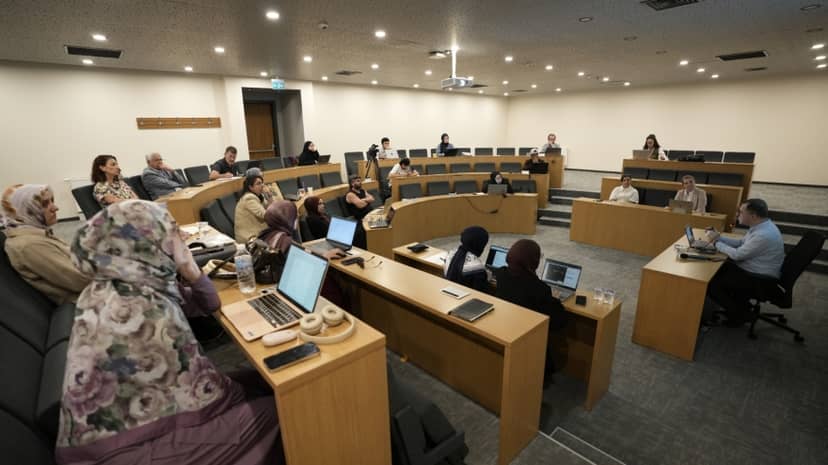
The launch of the ‘AI-Supported Social Science Research’ (YADESA) project, led by Dr. Sümeyye Uyar from our university’s Department of Political Science and International Relations and approved for implementation with the support of the Istanbul Development Agency, was held at Ibn Haldun University.
The launch of the “AI-Supported Social Science Research (YADESA)” Project, led by Dr. Sümeyye Uyar from the Department of Political Science and International Relations at Ibn Haldun University and supported by the Istanbul Development Agency (ISTKA) under the 2025 Artificial Intelligence Technologies Financial Support Program, was held. The program, organized on Wednesday, 19 November 2025, was attended by our Rector Prof. Dr. Atilla Arkan, Secratary General of the Istanbul Development Agency (ISTKA) Dr. Ziya Taşkent, and Istanbul Deputy Governor Okan Leblebicier.
“We Aim to Become a University that Integrates Artificial Intelligence Into the Social Sciences”
Speaking at the launch event, our Rector Prof. Dr. Atilla Arkan emphasized that our university has been advancing with the mission of integrating artificial intelligence literacy into the social sciences for the past four years. He noted that the academic value of research that does not effectively incorporate AI is gradually diminishing, underscoring the necessity of establishing qualified infrastructures for data collection and analysis.
Highlighting that power dynamics across various fields—from politics to economics—are increasingly shaped by data and artificial intelligence, Prof. Dr. Arkan added that AI-related courses that began as electives at Ibn Haldun University have now evolved into doctoral studies, funded projects, and robust research infrastructures. He drew attention to the importance of cultivating a new generation of social scientists capable of anticipating the future and producing data-driven policies.
“A Model Project For Future”
Secretary General of ISTKA Dr. Ziya Taşkent began his speech by emphasizing that the Agency is a public institution responsible for collecting information, producing reports, conducting regional planning, and providing financial support. He noted that the project aligns closely with the Agency’s objectives and addressed the role of universities in knowledge production, particularly pointing to the project’s focus on artificial intelligence within the social sciences and its emphasis on human capital development.
Dr. Taşkent also emphasized that universities undertaking exemplary projects of this nature play a critical role in regional development.
“No Scientific Knowledge Can Be Produced Without Data Processing”
Istanbul Deputy Governor Okan Leblebicier, in his remarks, stated that AI literacy has become essential in the social sciences. He emphasized that scientific knowledge production is hindered when data is not processed accurately and stressed the necessity for every student working in the social sciences to become competent in artificial intelligence. He noted that data now stands at the very center of scientific inquiry.
“We Aim to Broaden AI Literacy in the Social Sciences”
During the launch event, Dr. Sümeyye Uyar, the project director, delivered a presentation outlining the main objectives and long-term vision of YADESA. She explained that she received preparatory AI-related training and participated in various studies during her doctoral period, highlighting the importance of social scientists taking an active role in the field in an increasingly dynamic and developing world.
Dr. Uyar emphasized the significance of cultivating human capital with competence in data processing and analysis, noting that current large language models tend to position social scientists merely at the interpretive stage. She stressed the necessity of prioritizing data analysis, examination, and active engagement in the field. She also stated that the project aims to establish an AI education model in which social scientists take an active role from the very beginning of the process.
She explained that the two primary outputs of the project are a one-year comprehensive training program and the establishment of a 10-person AI-Supported Textual Analysis Laboratory. The laboratory will equip participants with technical skills in text data collection, processing, and analysis, with the goal of enhancing the capacity of social scientists to produce high-quality data through active fieldwork.
The launch event concluded with a group photo session.
YADESA, which includes Assoc. Prof. Dr. Ali Aslan, Laboratory Coordinator Res. Asst. Mustafa Yıldırım, and project assistant and master’s student Tuğçe Aşan as part of the project team, aims to promote the use of artificial intelligence in the social sciences through winter and summer schools, applied training programs, and the analysis laboratory. The project seeks to cultivate qualified human capital and establish a pioneering model in this field in Türkiye.
Photos


Related Content
Our Vice Rector, Prof. Dr. Yeliz Bozkurt Gümrükçüoğlu, Accepted into the COST HARPA Action Working Group

Five Academics from Our University Join a Project on Digital Transformation in the Judiciary

Faculty of Law Academic Dr. Gülnihal Ahter Yakacak Accepted into the COST HARPA Action Working Group
Vice Rector Prof. Dr. Yeliz Bozkurt Gümrükçüoğlu Accepted to a Working Group of the COST ELDA Action

Faculty Member Dr. Serdal Tümkaya Accepted to a Working Group of the COST KGELL Action
“Digital Vulnerability” Project Receives TÜBİTAK 3005 Funding

Erasmus+ KA220-YOU Support from the Turkish National Agency for the PeerMed4Youth Project
International Collaboration on AI-Supported Teacher Education under Erasmus+ KA220: The AI4PD Project